Ever wondered what makes your property valuable if the government wants to take it? You might hear the terms “highest and best use” and “current use” thrown around, especially if you’re facing an eminent domain situation. Understanding the highest and best use vs current use of your property can make a big difference in how much compensation you’re offered. In this guide, you’ll learn what these terms really mean, how they’re used, and why they matter for property owners like you.
1. What Does “Current Use” Mean?
When someone talks about the “current use” of your property, they’re simply describing how your property is being used right now. This could be anything from a small family home to a vacant lot, a retail store, or farmland. The current use is the actual, day-to-day function of the property as it stands.
For example, if you own a corner lot where you run a small coffee shop, that’s its current use. Or if you have a piece of land that’s just sitting empty, its current use is “vacant.” Maybe you have a house you rent out to college students, or you operate a small auto repair shop, those are both current uses, too.
Current use is usually straightforward and easy to spot. It’s what you see when you drive by or what you put on your tax forms. Often, it’s the use listed on your property tax bill or insurance policy. But when it comes to eminent domain and getting fair compensation, current use is just the starting point. It’s important, but it doesn’t always show the property’s full potential.
2. What Is “Highest and Best Use”?
The “highest and best use” is a bit more involved. This term refers to the most profitable, legal, and physically possible use of your property, not just what it’s doing today. Think of it as your property’s ultimate potential, given zoning rules, market demand, and physical features.
Let’s say that coffee shop sits on a busy intersection in a growing city. If the land could legally be turned into a three-story apartment building that would make you more money, then the highest and best use might be residential development, even if you’re currently selling lattes there. Or suppose you own a vacant lot in a city center where new restaurants and offices are popping up. The highest and best use could be commercial development, not just an empty lot.
Appraisers, lawyers, and government agencies all look at the highest and best use when deciding how much your property is worth in an eminent domain case. This concept isn’t just about dreaming big, it has to be possible, legal, and supported by the market. If you can’t actually build that apartment building because of zoning laws or a lack of demand, then it’s not considered the highest and best use.
3. Comparing Highest And Best Use Vs Current Use
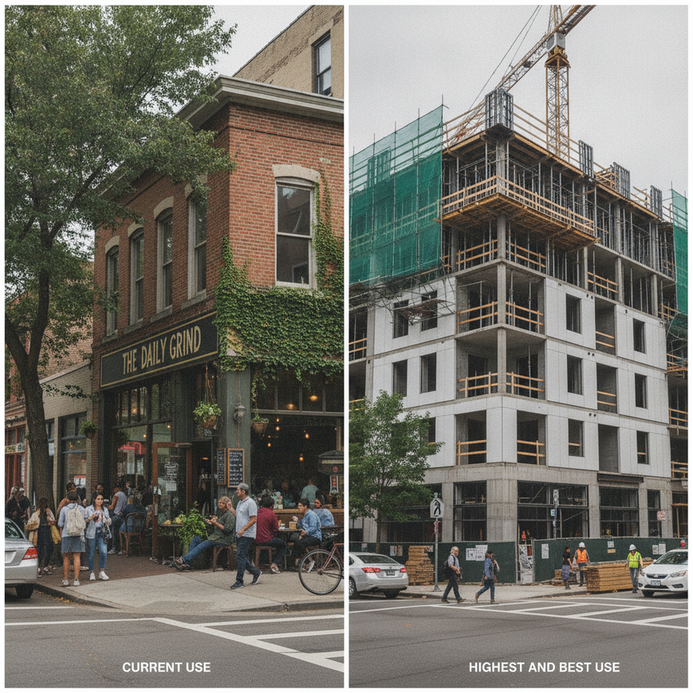
So how do these two ideas stack up against each other? Here’s a closer look at the highest and best use vs current use comparison:
-
Purpose: Current use focuses on what’s actually happening now. Highest and best use looks at what could happen, within the law and market conditions. For example, a parking lot is simple and clear as a current use, but its highest and best use might be a much taller office building if local laws and demand allow.
-
Value: Properties are sometimes worth more based on their highest and best use, not just what they’re doing right now. For instance, a simple parking lot in a booming downtown might be worth much more if it could become a hotel. The value of a property can change dramatically if the highest and best use is more valuable than the current use.
-
Legal Restrictions: The highest and best use must still follow zoning laws and environmental rules. It’s not just wishful thinking, it has to be realistic, legal, and possible. For example, you can’t turn a house into a nightclub if the city doesn’t allow commercial development in that area. Zoning, local laws, and even deed restrictions set the boundaries.
-
Compensation: If your property is taken by eminent domain, you could be entitled to compensation based on the highest and best use, especially if it’s clear your property could soon be used for something more valuable. This can make a big difference in the amount you receive. If the local government plans to build a new road through your land, and nearby properties are selling for much more because they’re being redeveloped, you may be able to argue for higher compensation.
-
Timing: Sometimes, a property’s highest and best use isn’t its current use, but a use that’s just around the corner. Maybe the area is being rezoned, or a new development is planned that will make the land more valuable. Appraisers can look at these “reasonably probable” changes if there’s real evidence they’ll happen soon.
4. Why Does This Matter for Property Owners?
If the government wants your land, the compensation you receive might depend on whether they look at the current use or the highest and best use. Here’s why that matters:
Picture a family farm on the edge of a growing suburb. Its current use is agriculture, growing corn, raising chickens. But if new shopping centers and neighborhoods are popping up nearby, the land might soon be worth much more as housing or retail space. In this case, the highest and best use is probably not farming anymore.
If compensation is based only on the land’s current use, you might get paid like it’s just a farm. But if the highest and best use is recognized, you could receive a much higher amount, reflecting what the land could become. On the flip side, if your property’s current use is already its most valuable use, like a high-rise office building in a busy city center, then the current use and highest and best use are the same. In that case, there’s not much difference in value.
Understanding the highest and best use vs current use difference helps you know what arguments you (and your lawyer) should make. You don’t want to leave money on the table just because someone only looked at how you use your land today. Knowing the difference makes you a better advocate for yourself, especially when every dollar counts.
It also helps you plan for the future. If you’re thinking about selling, refinancing, or redeveloping your property, knowing its highest and best use can help you make smarter decisions. You might discover hidden value you didn’t realize was there.
5. How Is Highest and Best Use Determined?
Appraisers and legal experts look at several things to figure out your property’s highest and best use. They usually consider:
-
What’s physically possible? (Is the land big enough or flat enough?) Is there access to roads, utilities, and other services? If the land is too small or too steep, some uses won’t work. For example, a narrow lot on a hillside might not be suitable for a shopping center, but it could be perfect for a small apartment building.
-
What’s legally allowed? (Are there zoning restrictions or environmental limits?) Every city and county has rules about what you can build and where. If a property is zoned for residential use, you can’t just put up a factory. Sometimes, special permits or changes in zoning can open up new possibilities, but those take time and aren’t always guaranteed.
-
What’s financially feasible? (Would the new use actually make money?) It’s not enough for a new use to be possible and legal, it has to make sense financially. Appraisers look at construction costs, expected rent or sales prices, and market demand. If building a hotel would cost more than anyone could ever make back in that area, it’s not the highest and best use.
-
What’s most profitable? (Which use would give the highest return?) After considering what’s possible, legal, and financially sensible, appraisers figure out which use would produce the highest value. Sometimes, the answer is clear. Other times, experts have to dig into local market trends, recent sales, and future development plans.
The answers to these questions help decide if your property could be worth more than its current use suggests. For example, if a vacant lot is zoned for commercial buildings and there’s demand for new shops in your area, its highest and best use might be retail development, even if it’s just empty land today.
In some cases, changes in the neighborhood can shift the highest and best use over time. Maybe a new school, highway, or shopping center is opening nearby. These changes can turn ordinary properties into highly valuable ones. Appraisers and attorneys often use maps, city plans, and expert testimony to prove what’s possible and what the market really wants.
6. Real-Life Examples: Highest And Best Use Vs Current Use
Examples make these concepts clearer. Imagine you own a warehouse on the edge of a city. Lately, the city has been expanding, and new apartment buildings are popping up nearby. Your warehouse’s current use is for storage, but the highest and best use could be a residential complex if zoning allows it. That could greatly increase the property’s value in an eminent domain case.
Or think of a family farm next to a new highway project. The current use is agriculture, but if the area is set to be rezoned for commercial use, and there’s demand for gas stations and restaurants, the highest and best use might be commercial development. That could mean a much bigger compensation check if the government takes your land.
Let’s look at a few more practical examples: