If the government wants to take part of your property for a road or public project, you might wonder what happens next. West Virginia partial taking compensation laws are designed to make sure you’re paid fairly, but the process can be confusing. This guide explains what partial taking means, how compensation is decided, and what steps you can take to protect your rights.
What Is Partial Taking in West Virginia?
Partial taking happens when the government uses its power of eminent domain to take only a portion of your property, not the whole thing. This usually happens for things like road expansions, utility lines, or flood control projects. Instead of buying your entire property, the government buys just what it needs.
If you’re facing this, you’re not alone. Many West Virginia property owners have questions about what they’re owed and what to expect. The good news is, the law says you must be compensated not just for what’s taken, but also for any loss in value to the rest of your property.
How Is Compensation Calculated?
Compensation for a partial taking is more than just the value of the land taken. The main goal is to make sure you’re left in a similar position as before the taking.
Here’s how it usually works:
- The value of the land or property actually taken is determined first.
- Then, any damages to the remaining property (often called “severance damages”) are calculated. These damages cover things like reduced access, loss of parking, or changes that make the property less useful or valuable.
- If the project actually improves the value of your remaining land, that benefit may be deducted from your compensation, but only if it directly results from the project.
For example, if a new road makes your business more accessible, the increased value could offset some damages. But if the road cuts off your main driveway, damages could be higher.
What Counts as Damages?
West Virginia partial taking damages include more than just the land lost. Common types of damages are:
- Loss of access to roads or driveways
- Reduced visibility for businesses
- Changes that hurt the usefulness or enjoyment of your property
- Loss of parking or important features like landscaping
If the government project leaves you with odd-shaped land or makes it harder to develop or sell your property, those are also considered damages. In some cases, even the emotional impact or inconvenience can factor into negotiations, though the law focuses on actual financial loss.
The Condemnation Process: What to Expect
The process starts with a notice. You’ll get a letter or visit from a government representative explaining what land is needed and why. It’s important not to sign anything right away or accept the first offer. The initial offer may not reflect the true value, or all the damages.
Next, the government will usually send an appraiser to evaluate your property. You have the right to get your own independent appraisal, and many property owners do this to make sure nothing is missed.
If you and the government can’t agree on a fair price, the case may go to court. In West Virginia, courts look at both the value of the land taken and any loss in value to what remains. This is where having a lawyer who understands west virginia partial taking compensation can make a big difference.
Protecting Your Rights: Steps to Take
If you’re facing partial property taking, here’s what you can do to protect your interests:
- Don’t rush into signing anything. Take time to understand your rights and the full impact on your property.
- Gather all documents about your property, deeds, surveys, business records, and photos.
- Consider hiring your own appraiser to get a second opinion on value and damages.
- Talk to an eminent domain lawyer early. They can help you spot issues, negotiate with the government, and, if needed, go to court to fight for fair compensation.
These steps help you stand up for your property rights and avoid settling for less than you deserve.
Why Legal Help Matters
Dealing with west virginia partial taking compensation can be overwhelming, especially if you’ve never gone through it before. The laws are complex, and the government has its own team of lawyers and appraisers. Having an experienced lawyer on your side levels the playing field. A good lawyer can explain your options, uncover damages you might not realize, and negotiate for the best possible result. In many cases, property owners recover more, sometimes much more, than the original offer.
Common Questions About Partial Taking in West Virginia
Will I have to pay taxes on my compensation?
Compensation payments may have tax consequences, depending on how the money is used and your specific situation. It’s a good idea to consult a tax professional before making any decisions.
What if only part of my property is taken, but the rest is no longer usable?
If the remaining property is no longer practical to use or live on, you may be eligible for additional damages or even a full buyout. Every case is different, so it’s important to get advice tailored to your situation.
Can I challenge the government’s right to take my property?
In some cases, yes. The government must prove that the taking is for a “public use” and that proper procedures are followed. An experienced lawyer can help you challenge the taking if there are grounds.
[Inline image placeholder: A detailed property map showing a West Virginia lot with a highlighted area for partial taking, neighboring properties, and a nearby construction site.]
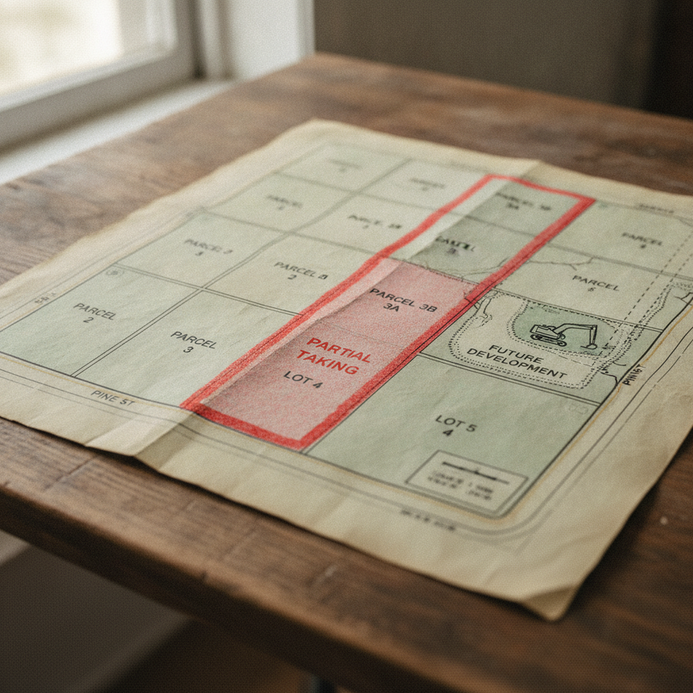
Prompt: A high-resolution, top-down view of a West Virginia property map showing a single lot with a section highlighted in red to represent partial taking. The map includes boundary lines, adjacent lots, and a nearby construction area. Clean, simple style, suitable for illustrating land division.
Conclusion
Partial taking can feel like a big disruption, but you have important rights under West Virginia law. Fair compensation is more than just the value of what’s taken, it includes losses to your remaining property. With the right help, you can stand up for your property and receive the compensation you deserve. Contact us to learn more.